

Some Thoughts on Doping, the Enhanced Games, and Fred Kerley
And why I think this is a great move for Kerley

Fred Kerley recently announced he signed to The Enhanced Games, a startup athletics event where you don’t have to follow doping rules set by the World Anti-Doping Association (WADA) and are allowed, but not required, to take performance enhancing drugs (PED’s). As you can imagine, it’s controversial. Their ethos hinges on a few points:
Pushing the absolute limits of human performance using science
Paying athletes what they deserve.
Leveling the playing field because sports are not 100% clean anyway.
Giving athletes freedom to choose what to do with their body.
Due to all of the doping stories in my lifetime, most notably cycling and baseball, people like me have always wondered what would happen if we just make everything legal. The biggest bottleneck to that is money. Someone has to pay for it. And they have to pay enough to draw in actual athletes, because you could pump me up with all the EPO or testosterone in the world and I’m not breaking a world record.
The Enhanced Games can do this because they’re financially backed by serious investors and venture capitalists like Peter Thiel. They have big money.
My First Viewpoint on the Enhanced Games
If I put my scientist hat on, I think it has the potential to produce some great human performance science. There’s really no great research on what most of these drugs actually do in the context of elite athletes because they’re not publicly volunteering to be studied, for obvious reasons.
With more PED research we may find out that some banned drugs don’t actually give a competitive advantage. I think this is true for many substances on the banned list. Many of them are banned simply on theoretical grounds or from animal studies. Understanding what actually works and what doesn't is important for several reasons. It improves our health/safety/medicine/performance knowledge, reduces costs (don’t have to test as many things), and could reduce unnecessary bans for truly unintended doping violations.
“Critical research in anti-doping organizations is critical for improving their governance. The lack of critical research in this area is a significant shortcoming” - Fabien Ohl (in this article)
Take trimetazidine for example, a heart disease drug that improves the heart’s use of glucose for energy when the tissue becomes hypoxic (lack of oxygen). A Russian figure skater got popped for it during the Olympics. However, there’s no evidence, even theoretical plausibility, that this would help a figure skater. Ben Levine, a renowned sports cardiologist, and other medical experts supported this view which you can read here and here. Did she intentionally take it? Was she forced by a coach? Did she have intent to cheat? Who knows.
But who cares if it doesn't actually work? The fundamental concept of the anti-doping code is to protect the value of the sport, integrity of the sport, and health of athletes. So if they find a substance that to our knowledge does not enhance performance or pose health risk, the rationale for a violation is not quite strong.
Trimetazidine was involved in doping violations of 23 Chinese swimmers in 2021, an American swimmer in 2018, a marathon runner in 2022, and a tennis player in 2024. Many of them had the decision reversed due to contaminated supplements. While they should have been more rigorous about their supplements, WADA should have more background knowledge before adding something to the banned list to avoid unnecessary bans, and also establish critical threshold limits for all prohibited substances. The latter of which was the topic of articles in 2012 and 2023.
Research is also critical for safety reasons. People are still doping and will continue to do so until the end of time. With rigorous medical research on PED’s, we will get a better understanding of their risk profile, not only right now, but also lifelong effects.
Ironically, if they publish their work, anti-doping agencies will actually benefit because no one else has this kind of information, besides maybe the historic East German doping program. A tangential effect of could even be skewing people away from doping that otherwise would opt to cheat if they see documentation of how these things affect elite athletes, instead of anecdotes.
So, perhaps selfishly, because I am interested in the science behind PED’s, I think there are some positives since it serves as a vehicle to answer these questions. I’m also operating under the assumption that they are indeed using advanced medical screening to ensure athlete safety and it’s not just “pump them up with all the drugs we can and hope for the best”.
Also, for reference, I nearly landed a job with these people as a scientist. Nearly everyone I met with was great but my final interview with the co-founder was very strange to say the least, and I didn't get it. I only bring that up because it would seemingly give me a good reason to shit on the whole thing.
My Other Viewpoint
At the same time, I do like the idea of a “natural” competition, which the Olympics, for instance, claims to be. Not everyone will be willing, or wants to, use PED’s, even if they work with the best doctors in the world that make it as safe as possible. So there certainly should be a competition that does not involve doping where athletes know that they are on the start line with other natural athletes.
I also simply love watching the Olympics, World Championships, Diamond League, etc.
And at the end of the day, rules are rules, and the International Olympic Committee (IOC) has the right to want their sport to be clean. Also, it must be absolutely gutting to miss out on the moment of an Olympic medal only to find out later the people who won were doping.
In my fantasy world I’d like to clone all of these best athletes in the world and have two competitions, one doped and one natural.
Where I think the Enhanced Games could be severely flawed is by not getting enough good athletes on the start line. Like I said before, you can’t just dope any random person to a world record. They need innate talent and physical ability. With Fred Kerley, they certainly stepped up in this aspect. But they need more.
In track events, you often see the best performances when athletes are competing. It’s much harder to break a world record doing a solo time trial than when you are neck-and-neck or chasing someone and actually racing.
We saw this in the women’s 400m at the 2025 World Championships when Sydney McLaughlin-Levrone ran the second fastest time in history. The two women behind her also ran the best races of their lives, which I doubt would have happened otherwise. The men’s 800m final at the 2012 Olympics was another great example where David Rudisha obliterated the world record and dragged everyone else behind him to their personal bests or national records.
Competition brings out the best in athletes, so for these world records to fall, the Enhanced Games needs more than just PED’s.
Doping Issues in Track/Running
I’m a realist at heart, and the fact is that many athletes are doping at the Olympics and other reportedly “clean” events. Look at Kenyan distance running. I’m not saying every Kenyan is cheating, but they clearly have a serious doping issue. Over 100 athletes are currently ineligible to compete for doping violations.
Let’s view it from their standpoint. Kenya is naturally a distance running hotbed and many of their athletes already have the innate talent and training environment to compete at the top level clean. Winning a major marathon pays a good bit, enough to make you rich back in Kenya. The prize money can be life changing.
Economically, Kenyan’s aren’t as well-off as us in the USA or other more developed countries. Taking EPO is almost a no-brainer as a means to get paid. As long as they collect a check, what should they care if they cheated? It’s not like it’s a criminal offense. The worst that happens is they are disliked by the running purists and banned from future events.
I’m not saying it’s right or wrong, it just is what it is.
Since I don’t want to pick on only Kenya and distance running, let’s look at the history of the men’s 100m sprint which is mainly USA and Jamaica. Currently, there are 11 men who make up the top-10 100 meter times in history. Among them, only 4 (Usain Bolt, Kishane Thompson, Oblique Seville, Trayvon Bromell) have made it through their career without any doping violations, whether that’s a whereabouts failure or a failed test.
You can’t deny it’s a historically dirty event.
“Olympic movement stakeholders must change their idealistic view of the fight against doping, recognize its limitations and uncertainties, and accept its complexity. This cultural change must be implemented in sports organizations to think about anti-doping beyond the binary opposition between cheats and clean athletes.” - Fabien Ohl (in this article)
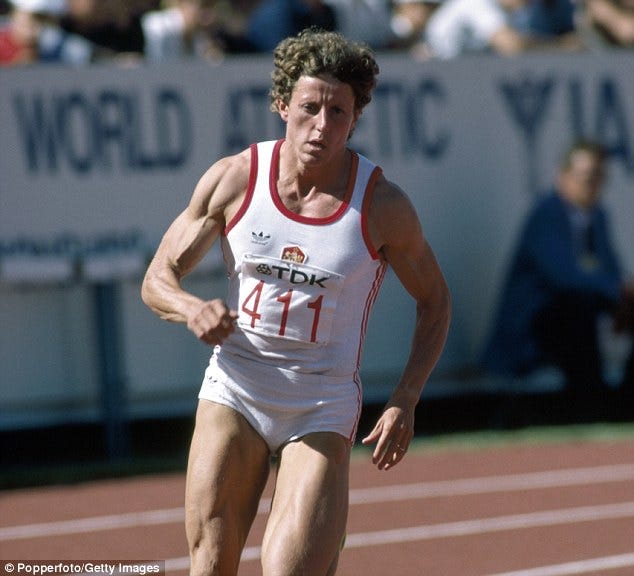
So you can’t look down on Fred Kerley for joining the Enhanced Games without having the same energy towards those other athletes in the top 10. There’s also several world records that still stand today because it was prior to the anti-doping revolution and they were never caught. WADA wasn’t formed until 1999! I recommend the book “Faust Gold” about the East German doping program. Or, just take a look at the women’s world record holder in the 800m and tell me if you think she was clean.
Why This is a Good Move for Fred Kerley
First of all, I’m a big fan Fred Kerley fan, so maybe I’m biased. He’s one of the best sprinters in the world. World Champion, 1x Olympic silver, 1x Olympic bronze, and one of the fastest 100m times ever. He’s also only one of 3 athletes to ever run the 100m in <10 seconds, the 200m in <20 seconds, and the 400m in <44 seconds. However, he’s 30 years old and sprinting is a young man’s game.
The next big global stage in sprinting is the 2027 World’s in Beijing and the 2028 LA Olympics, when he would be 33. Of course there will be other races in 2026 like the Diamond League, but that doesn’t carry near the same status as the World and Olympic Championships.
33 is not old, but in sprinting you’re pushing retirement. A gold medal in LA would make him the oldest 100m champion in history. While advances in training, nutrition, technology, and medicine have allowed certain athletes to extend their careers longer than expected, the odds simply are not in your favor as a sprinter.
The move to the Enhanced Games gives Kerley a chance to capitalize on his physical prime and focus on running the fastest 100m of all-time. Currently, he is provisionally suspended for whereabouts failures, which is when you miss 3 drug tests for not being where you said you would. Active elite athletes are put into a registered testing pool (RTP) and have to provide anti-doping authorities their schedules in the event they are selected to be drug tested (see picture below).
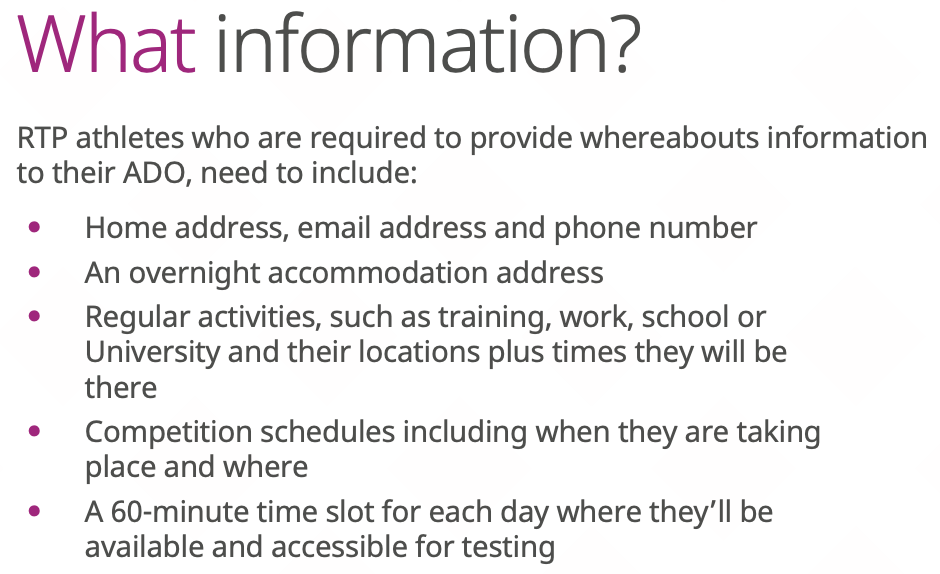
If you miss 3 tests in 12 months, you are subject to a 1-2 year ban:

This doesn’t mean you actually doped, but while he is contesting the decision and has not claimed to have taken anything illegal, the chances he competes in any standard races next year are slim. Kerley has also had some legal issues in the last year, and the culmination of these events have likely reduced his stock as an athlete in terms of sponsorships and sources of income.
It’s all about the Benjamin’s
Historically, track and field athletes are criminally underpaid. Many athletes go into debt to be able to compete, or have to fit their training in around full time jobs until they hopefully run fast enough one day to secure a shoe deal.
A select few big time athletes (Noah Lyles, Sha’carri Richardson, etc.) will make big money through private sponsorship deals and other ventures, but they still aren’t even in the same zip code as the NBA, NFL, or MLB. In boxing, Canelo Alvarez allegedly made as much as $150 million for his recent fight with Terrence Crawford. Even the lowest paid people in the NBA make at least ~$1.2 million per year (league minimum).
NBA ref’s even make more than most track athletes, and veteran ref’s allegedly can earn up to $30,000 per game in the NBA finals, almost as much as an Olympic gold medalist.
Prize money for Olympic gold varies by country. In the US you receive $37,500. That’s a slap in the face. The IOC had a revenue surplus of over $1 billion in 2024, and the US Olympic committee about $100 million (keep in mind 2024 was an Olympic year, too). The NBA and NFL were at about $10-20 billion. So one issue is where the money to pay the athletes will come from. Since there’s so many athletes in a large country like the U.S., it’s not realistic for a governing body to support them all.
Grand Slam Track tried to fix this in 2025, offering relatively big prize money for their unique event which drew in some of the biggest athletes in the world. But after a major investor pulled out, the athletes still haven’t collected a check.
So, financially, it’s literally a no-brainer for Kerley. With everything else going on it is hard to imagine him making any considerable money as a track athlete anywhere else. As their biggest athlete to date, I guarantee he signed a nice contract, plus appearance fees, and the potential for $1,000,000 if he breaks the 100m world record. There’s also something like a $500,000 prize pot for event winners.
“Unless they start paying athletes properly, people will put themselves first. The sport can't survive on outdated pay models. Athletes carry the product, but in the old system they're underpaid and overregulated. We're building something where they're supported, compensated, and protected.” - Fred Kerley
I can’t imagine he breaks the world record but who knows. It’s important to say that it wouldn’t be the first time people have set out to achieve an “artificial” world record. Nike tried it twice with the sub-2 hour marathon and sub-4 minute women’s mile. So, having events using illegal strategies to produce a world’s best time is not new.
However, I should mention that as recently as last week, Kerley vehemently stated on a podcast he is not taking any PED’s and doesn’t plan to. So he might just be treating it as another event to compete in, like how some athletes competed in Grand Slam Track.
The only argument against him doing it is basically just one based on morals/ethics. The vibe I get from tried and true track fans is that he is tainting the sport and his legacy. They seem to take pride in the fact they do it for the love of sport despite getting paid terribly. And I think that is great because sport is not just about money. But it’s also a bit self-righteous to think other people should be willing to go broke in order to keep a certain image for the sport.
If anything, the Enhanced Games is a far better option than people secretly doping and competing in clean events, because that is certainly still going on.
I personally see it as a smart business move and Kerley capitalizing on a rare opportunity, regardless of your opinion on the whole ordeal. What will be more interesting is to see who follows him. I imagine the downstream effects will be other bigger athletes joining him, which will eventually put pressure on traditional athletics bodies to improve the sport and pay athletes more. It can’t survive on the self-righteous philosophy if there are other ways to make far more money running.
Sean Langan has his PhD in exercise physiology. He is interested in how exercise training rewires our biology and harnessing the intersection of human physiology, technology, research, and coaching/training to improve human performance.
I thought you did a great job explaining both sides of the argument. I think a lot more needs to be done in order to show the effectiveness of these PEDs. It makes me think of the cases where trace amounts of nandrolone were found in athletes. I also know of a study that finds that substance in many over the counter supplements. With these small traces does it really give an athlete an advantage?
Interesting! I once wrote a profile of one of the most notorious doping doctors in cycling (good luck finding it online), and after our interview I came away thinking, this guy is like a mad scientist — all he cares about is how to make his athletes go as fast as possible. (Like a Ferrari, if you will.) Anti-doping rules were a minor inconvenience.