

Minimizing the oxygen deficit
The importance of VO2 kinetics in health and disease

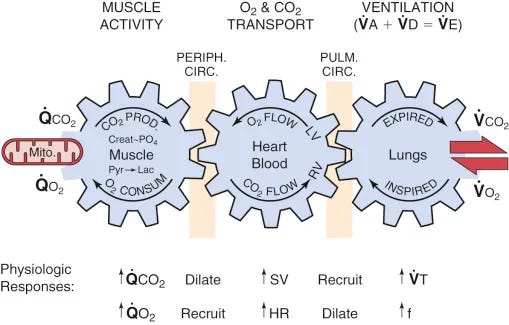
Exercise tolerance is exactly how it sounds - how much exercise you can tolerate until becoming fatigued and having to stop. I’ll primarily be talking about “dynamic” exercise (running, rowing, cycling) which refers to rhythmic muscle contractions of large muscle groups which is characterized by the percentage of oxygen uptake it takes to perform that activity.
In dynamic exercise, performance = oxygen. Specifically, how much total oxygen you can take in and use for energy at a maximal level (VO2max) and how much oxygen it costs you to perform an exercise submaximally (efficiency or economy). Ideally, you want a high VO2max and high efficiency (using less oxygen at a given workload).
When we go through a training program and our fitness improves, there are many adaptations taking place facilitating an increase in performance. You could write a book on all of these, so I’ll just list some major ones here involved in the cardiovascular system and transport/utilization of oxygen.
Increased VO2max
Increased stroke volume (blood pumped per heartbeat) and cardiac output (blood pumped per minute)
Lower heart rate at rest and during submaximal exercise
Lower blood pressure at rest and during exercise
Increased capacity of skeletal muscle blood vessels to dilate
Increased exercise economy (less O2 needed for a given running speed)
Larger plasma and red blood cell volume
Increased capillary density (the network of mini blood vessels in contact with skeletal muscles that exchange oxygen/carbon dioxide and nutrients)
Muscle fiber growth (fast or slow twitch depending what you do)
One set of adaptations that often gets overlooked, but is the focus of a lot of research, is the speed at which you can take up oxygen when you first start exercise, like the first minute or less. Since we usually exercise for longer than 1 minute this may not seem that important, but it actually has a lot of relevance for how we will feel/respond as the exercise bout progresses. Enter VO2 kinetics.
Kinetics in general refers to the time course of a given process. Pharmacokinetics details the time course of responses when you ingest a medication. Take a Tylenol and track the time it takes to be absorbed, appear in the blood, get metabolized, and excreted, then you have the pharmacokinetics of Tylenol. Here we’re talking about the rate at which the body, particularly skeletal muscles, consumes oxygen (VO2 = volume of O2) and uses it for biochemical reactions to produce energy.
At rest we consume about 250 mL of O2 per minute (resting or basal metabolic rate). Let’s say you are straddling the sides of a treadmill with the belt going at 6mph, and then suddenly jump on and start running. This speed requires a VO2 of 2,500 mL of O2 per min. The most efficient way to generate energy to meet this demand is by oxidative phosphorylation, a fancy way of saying using oxygen to create cellular energy (aerobic metabolism). However, this path takes a little time to kick into gear. The other option is by “anaerobic” metabolism, which results in less energy but the upside is that we get the energy much faster.
Anaerobic means without oxygen. To be clear you are still consuming oxygen if you’re breathing, but your muscle can use certain pathways that don’t require oxygen to create energy until the aerobic system gets up to speed.
As we suddenly start to run aerobic metabolism won’t instantaneously give us that energy, meaning we have to dip into anaerobic metabolism at first. This creates what is termed the “oxygen deficit”. I find that pictures often help:
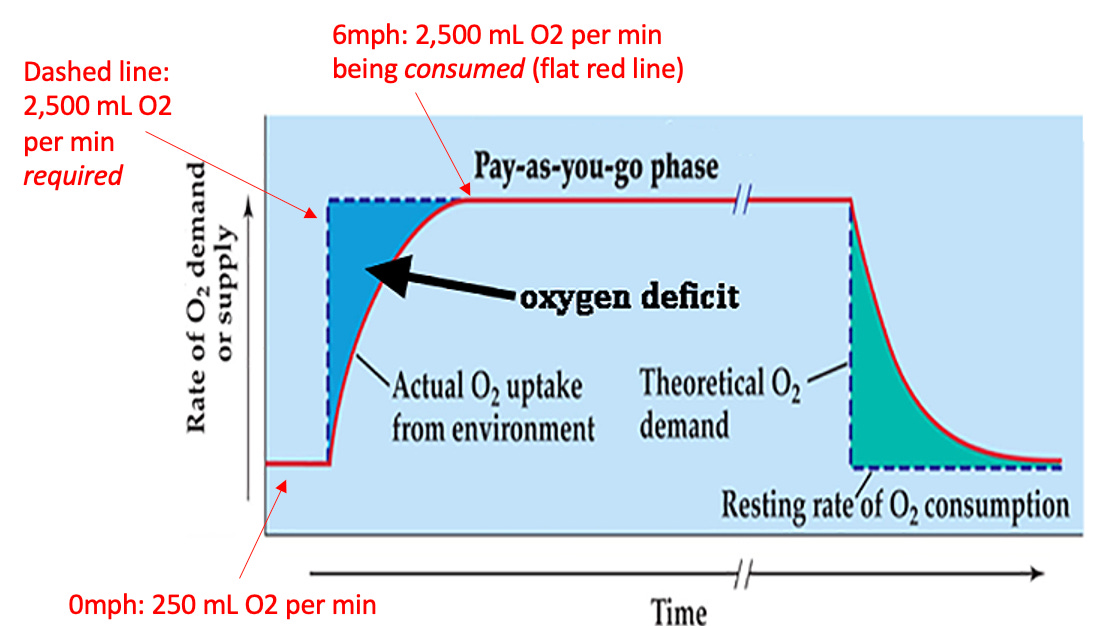
The red line is your actual O2 consumption (VO2). The dashed line is the 2,500 mL of O2 required to run at 6mph - it shoots up vertically because that is when you suddenly jumped on the moving treadmill. Call this your theoretical O2 demand. You’ll notice there is a gap between the red line and dashed line (shaded blue, labeled oxygen deficit). At this point, the muscular demand is too much for aerobic metabolism, so we use a backup plan to produce energy, without oxygen, until VO2 increases to match the demand. Ideally the red and dashed lines would overlap, so you don’t have to dip into this “anaerobic” metabolism. Unfortunately the body cannot work that fast, so even the most fit of us always have some sort of oxygen deficit.
Eventually the deficit goes away and the red line flattens out again. We have now reached the “steady state”. Generally, this a nice comfortable place to be. Keeping with the finance analogy, call this the “pay-as-you-go” phase. The demand is constant (at 6mph: 2,500 mL O2 per min), and as long as you keep running you are paying for that demand by consuming 2,500 mL O2 per min.
Later, we hop off the treadmill abruptly and stop running. The dashed line immediately falls. Now, theoretically, your O2 demand is no more than it was before you hopped on the treadmill. But we all know that we don’t feel completely at rest the instant we stop running. Our breathing rate, heart rate, blood flow, etc. are still elevated.
The space between the red curved line and black dashed line on the right (shaded in green) is the “oxygen debt”. Oxygen consumption remains elevated above the theoretical demand for a few minutes because we are paying back the deficit we incurred at the beginning of the exercise (blue shaded area on the left).
What’s the relevance of this? If we increase the speed at which our VO2 reaches the steady state, we make blue shaded area (oxygen deficit) on the graph smaller. As a result, we dip into our anaerobic energy system less and reach the more comfortable steady state in a shorter amount of time.
Anaerobic energy production is unsustainable because 1) it’s limited in how much energy it can produce and 2) the byproducts of this pathway eventually accumulate to a level that lead to fatigue and that painful burning sensation. So by increasing the speed at which our VO2 can increase to meet the demand, we rely on anaerobic metabolism less and limit creating an unstable environment in the muscle. It is this unstable environment that leads to exercise intolerance. If you’re less aerobically fit, you spend more time in this unstable zone which is unpleasant and drives you to fatigue sooner.
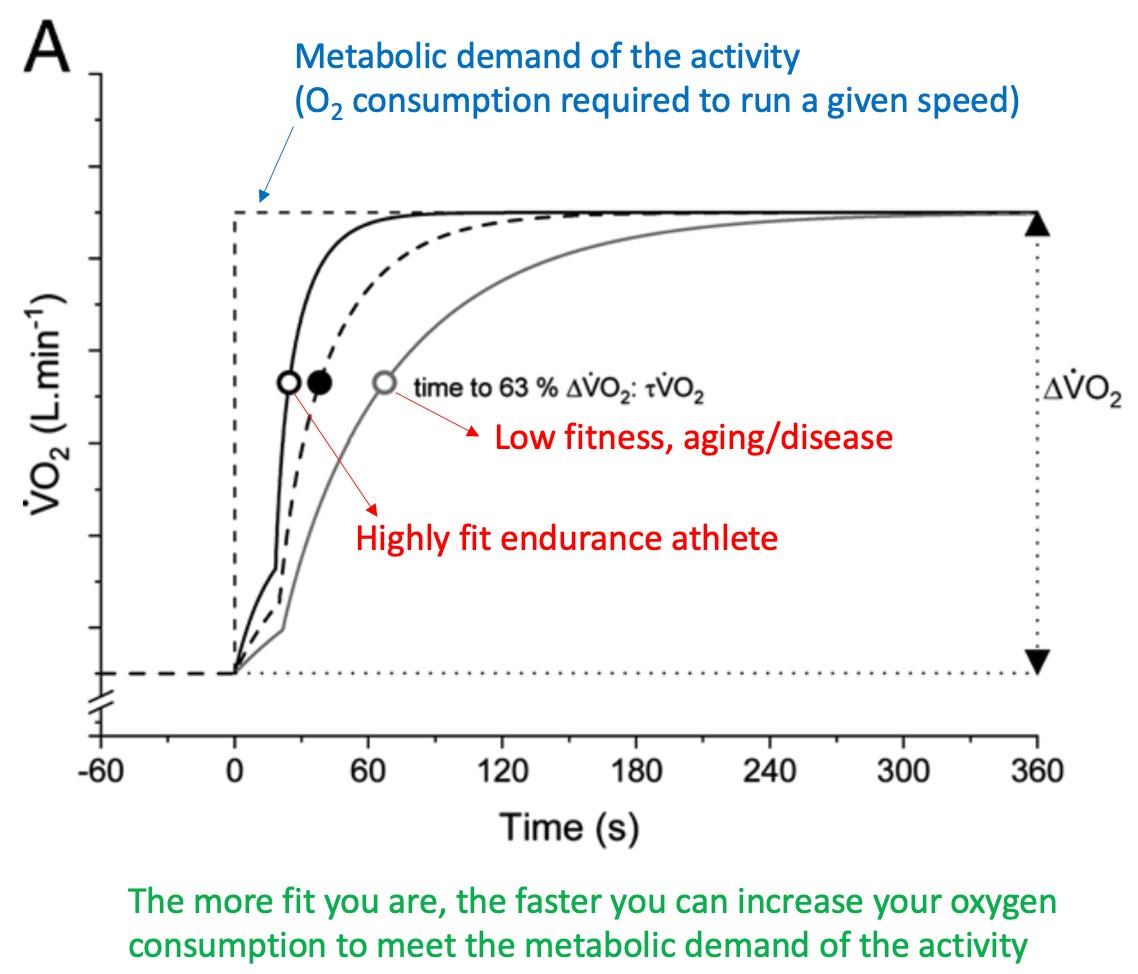
The way you can analyze this is using some math to determine the time constant of the VO2 response. I’m not a huge math person. But basically the mathematical definition is how long (in seconds) it takes you to reach 63% of the steady state response to a step-increase in exercise intensity. In our previous example, the step-increase is from 0mph to 6mph, suddenly “stepping” from one intensity (rest, 0mph) to a higher one (6mph). The circles on each of the curved lines in the picture above show this value (VO2 time constant) for each person, which are about 20, 35, and 65 seconds each, and correspond to reaching steady state at about 1, 3 and 5 minutes.
The best endurance runners in the world have a VO2 time constant of about 12 seconds, and this is highly related to their best marathon time, making it relevant for sports performance. Contrast this to someone chronic obstructive pulmonary disease (COPD) where it may be about 120 seconds! So in such patients with severe disease, it takes them a while to to reach steady state, meaning they dip into anaerobic energy production for much longer, making even modest forms of exercise (brisk walking) a significant challenge.
There’s debate about the specific mechanisms responsible for fast or slow VO2 kinetics but that’s unimportant here. It’s more important to understand that it can be improved through exercise training, with high intensity intervals and steady state easy aerobic training both likely providing benefit.
Supplements such as beet root juice can also speed this process along. When young healthy people supplemented with beet root juice for 6 days, they sped up the VO2 kinetics by 10 seconds and exercised for 22% longer at the same intensity before they had to quit. In elite athletes this probably has less of an effect because they are already so good at this it is hard to become much better.
Another quick trick to enhance this process is through a specific warm up, known as “priming” exercise. During an endurance event, it would be beneficial to limit the oxygen deficit as much as possible. By doing some hard exercise prior to the gun going off, you can speed up the subsequent VO2 kinetics when you launch off the start line. This could look like a hard 200m run 10-15min prior to a 1 mile or 5km race. It is probably most relevant for shorter, middle-distance (like the 1500m or 1 mile) events where the oxygen deficit takes up a larger portion of the race distance.
It sounds counterintuitive, but is certainly worth giving a try. Don’t try to PR in the warm up. It should be at a pretty hard effort but not so much to leave you not feeling fresh at the start line. Essentially it primes your skeletal muscles and vascular system to be able to take up oxygen when you go to start the race.
Next time you’re out on a run at a steady pace, see if you can notice this process at work in yourself. The slight discomfort when you first start that slowly wears away as you reach the steady state. It’s fun to know what’s going on under the hood!